Back from the Field
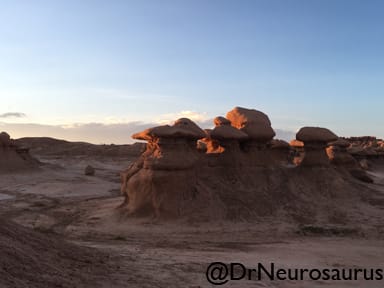
I’m back from a wonderful trip to the Hanksville Dinosaur Quarry in Hanksville, Utah. This excursion is led by the Burpee Museum of Rockford, Illinois, a spectacular regional Natural History Museum known for its top-notch research collections and impressive exhibits. I’ll talk about the day-to-day activities and how we find and extract fossils in quarries.
Day to Day:
The day started at 8 am with a delicious breakfast prepared by the local restaurant, Blondies. We then headed back to basecamp to gather all of our gear for the day, fill up the coolers with ice water and lunches, and drive to the quarry. It was about a 20-minute drive, mostly along a county road with amazing rock exposures.
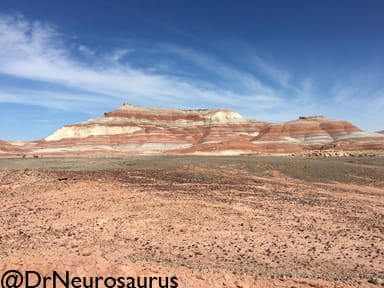
By the time we reached the quarry, temperatures were climbing into the high 90s°F. We worked until around 12:30 and then broke for lunch under the break tent. Work continued until about 3:30, when temperatures peaked (the highest was about 104°F) and another break was needed.
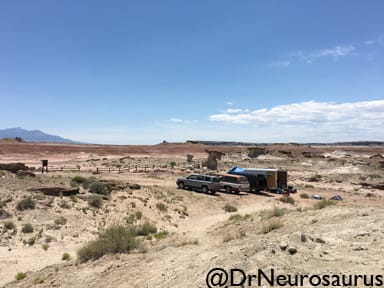
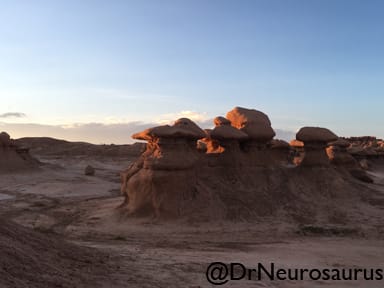
Work continued until 5 or 5:30, then we packed up and returned to basecamp for showers, dinner, and an evening activity. Sometimes that meant visiting a state park, like Goblin Valley State Park. Other times, we waited until dark and went out to look at the stars.
Extracting Fossils:
Extracting fossils from a quarry was not something I had done before. We used a tool called an ME-910, which is essentially a mini jackhammer. It chips away the rock little by little so you can locate hidden bone and safely remove the surrounding rock.
[VIDEO 2016-06 IMG_7535.mp4]
Once the fossil is found, we remove the surrounding rock, leaving it on a small pedestal. We never completely remove the bone from the rock in the field because it can easily break. Keeping it encased in rock stabilizes it until it can be taken back to a museum for further preparation.
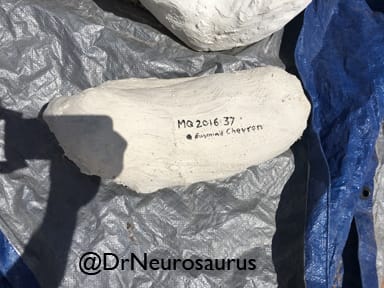
Next, the bone (a dinosaur chevron) is ready for plaster. This part feels a bit like an arts and crafts project. First, you cover the bone in wet paper towels to protect it from the plaster. Then it gets a layer of tin foil. Finally, we use burlap and plaster to create a protective jacket.

The plaster jacket receives a field number and label and is mapped in the quarry so the collections manager knows exactly where in the rock that bone was found.
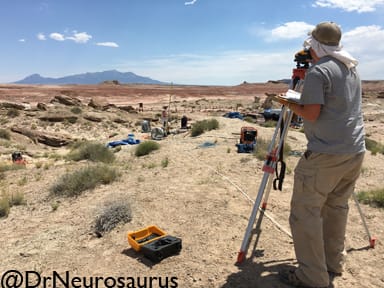
Next time I’ll talk about how we prospect (look for fossils in new places), the wildlife we saw, and share some photos of the remarkable geology.


Comments ()